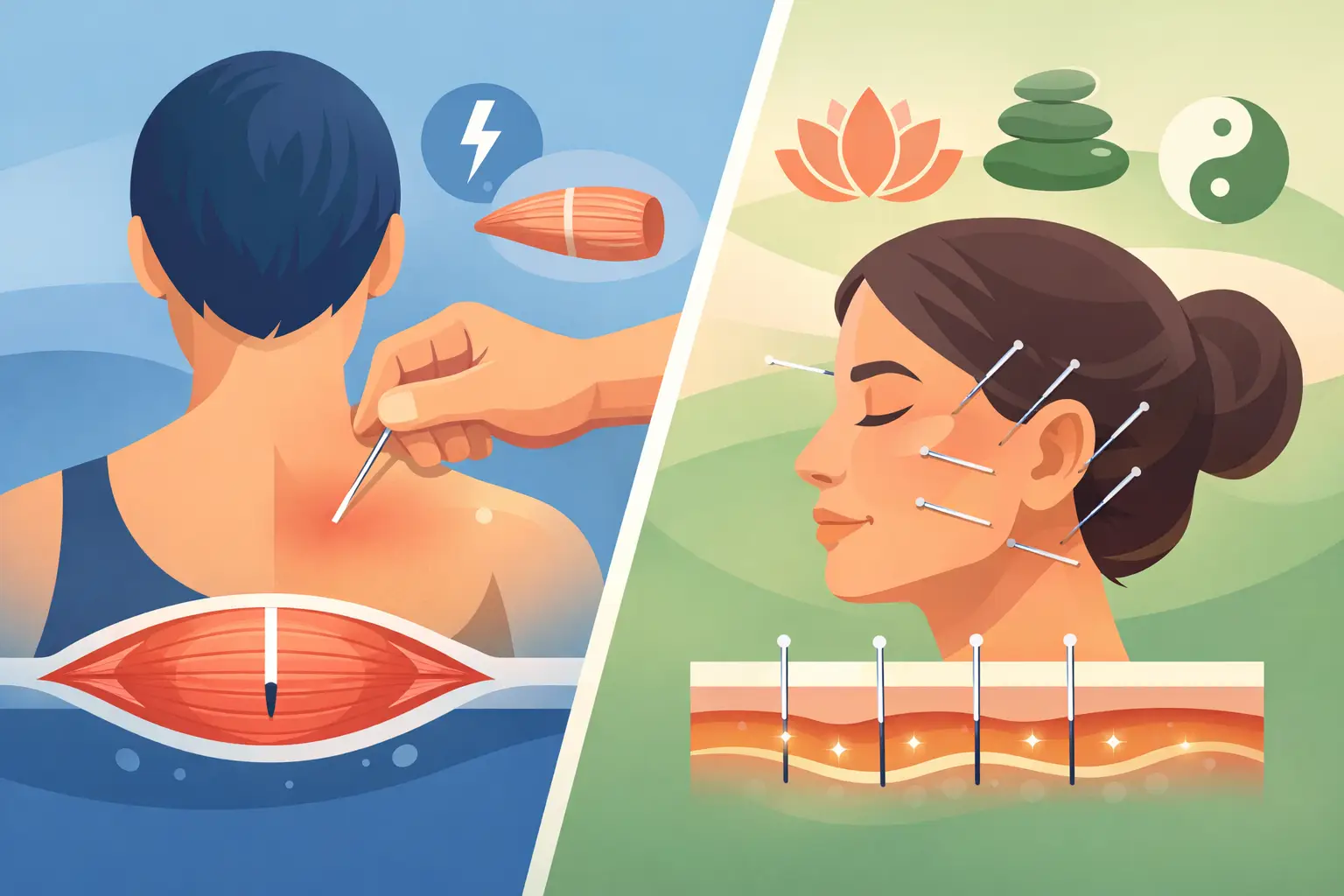
Dry Needling vs Acupuncture Explained
If you have been told dry needling might help with heel pain, calf tightness or a stubborn sports injury, it is natural to ask about dry needling vs acupuncture. Both use very fine needles, and from the outside they can look similar. The difference is in why they are used, how they are applied, and what the treatment is trying to achieve.
For podiatry patients, that distinction matters. When pain is affecting the feet or lower limbs, the goal is usually to improve movement, reduce muscle tension and support recovery so you can get back to walking, working or training with less discomfort.
Dry needling vs acupuncture: the key difference
The clearest way to understand dry needling vs acupuncture is to look at the treatment approach behind each one.
Dry needling is based on modern musculoskeletal assessment. It is commonly used by allied health professionals to target tight muscles, trigger points and areas of tissue irritation that may be contributing to pain or restricted movement. In podiatry, that often means muscles and soft tissues in the feet, calves and lower limbs.
Acupuncture comes from traditional Chinese medicine. It uses needles placed at specific points on the body according to a broader treatment framework. People may seek acupuncture for a wide range of concerns, not only muscle pain, and the reasoning behind point selection is different from the way dry needling is typically used in a podiatry setting.
So while both treatments involve fine needles, they are not simply two names for the same thing.
Why podiatry patients often ask about it
A lot of lower-limb pain is not just about the exact spot that hurts. Heel pain can be linked to tight calf muscles. Forefoot discomfort can be influenced by how the ankle moves. Shin and Achilles issues often involve muscle overload higher up the chain.
That is why dry needling may be considered as part of a broader treatment plan. It is not usually a stand-alone fix. Instead, it may be used alongside hands-on care, stretching, strengthening, footwear advice, load management, orthotics or shockwave therapy, depending on the condition.
For someone comparing dry needling vs acupuncture, the real question is often this: are you looking for treatment aimed at a musculoskeletal foot or leg problem, or are you seeking a different style of care based on traditional acupuncture principles?
How dry needling works in a podiatry setting
Dry needling is typically used to target areas of muscle tension, trigger points or overworked soft tissue. The needle is inserted into specific muscles to help reduce tightness and irritation. For some patients, this may help ease pain, improve flexibility and make movement more comfortable.
In podiatry, it may be considered for issues such as plantar heel pain, calf tightness, Achilles discomfort, shin pain or lower-limb muscle strain. It can also be relevant where altered movement patterns have placed extra stress on certain tissues.
The treatment is usually guided by a clinical examination. That means the practitioner is not choosing needle points at random. They are looking at your symptoms, the involved tissues, your movement, and what seems to be driving the problem.
This is one reason dry needling often appeals to patients who want a practical, results-focused approach. It is aimed at a specific physical issue and is usually used as one part of a clear treatment plan.
How acupuncture differs
Acupuncture also uses fine needles, but the treatment framework is different. Traditional acupuncture is based on concepts and diagnostic methods that sit outside standard musculoskeletal podiatry practice. The practitioner may choose points that are not located only where the pain is felt, because the treatment is based on a wider understanding of the body.
That does not make one method automatically better than the other. It means they are designed with different purposes in mind.
If your main concern is foot or lower-limb pain linked to muscle overload, movement issues or a sports injury, dry needling is often the more direct comparison because it is usually applied with that kind of physical problem in focus. If you are specifically seeking traditional acupuncture care, that is a separate service with its own methods and goals.
What treatment feels like
One reason people hesitate is simple – they do not love the idea of needles.
In practice, both dry needling and acupuncture use very fine needles, much thinner than the ones used for injections or blood tests. Even so, the sensation can vary. With dry needling, patients may feel a twitch, a cramp-like response or a brief ache when a tight muscle is targeted. That response can be part of the treatment effect.
Afterwards, it is common to feel some temporary soreness, a bit like post-exercise muscle fatigue. For most people, this settles fairly quickly.
Acupuncture sensations may differ depending on the style of treatment and the points used. Some people describe a mild ache, warmth, heaviness or tingling. The experience is not identical from one approach to the other, even though both involve needles.
Is one better than the other?
It depends on what you are treating.
For a podiatry-related problem such as calf tightness contributing to heel pain, dry needling may be more directly relevant because it targets the soft tissue issue identified during assessment. It fits within a musculoskeletal treatment plan and is often chosen because it supports a broader goal: improving how the foot and lower limb function.
That said, dry needling is not the answer for every patient. Some people respond better to exercise-based treatment, footwear changes, orthotics, manual therapy or reduced training load. Others may benefit from a combination of approaches.
There are also times when needling may not be suitable, such as with certain medical conditions, skin issues, needle anxiety or if the likely benefit is limited. Good care is not about using a treatment because it is available. It is about choosing it when it makes sense for the person in front of you.
Dry needling vs acupuncture for foot and leg pain
When comparing dry needling vs acupuncture for foot and leg pain, the most useful question is what is causing the pain.
If the issue is muscular, tendon-related or linked to movement and load, dry needling may have a clear role. A podiatrist might use it to address calf tightness affecting plantar fasciitis, muscle trigger points associated with shin pain, or lower-limb tension that is changing the way you walk.
If the problem is coming from footwear, joint mechanics, overload, diabetes-related risk, skin or nail conditions, dry needling may have little or no role at all. In those cases, a different treatment path is more appropriate.
That is why assessment comes first. Similar symptoms can have very different causes, and the right treatment depends on understanding what is actually happening.
What to ask before you book
If you are deciding between services, ask what the treatment is aiming to address. For musculoskeletal foot and lower-limb pain, it is reasonable to ask whether the practitioner will assess your biomechanics, identify the tissues involved and explain how needling fits into the wider plan.
You can also ask what results are realistic. Dry needling may help reduce pain and tension, but it is not magic. If a tendon is overloaded or your footwear is aggravating the problem, those factors still need attention.
For local patients, a clinic like Ian’s Podiatry may use dry needling as part of practical lower-limb care rather than as a one-size-fits-all service. That tends to be the most useful way to think about it – not as a trendy add-on, but as one option among several evidence-informed treatments.
The bottom line for patients
Dry needling and acupuncture may look alike, but they come from different treatment models. Dry needling is generally used to target muscles and soft tissue dysfunction in a modern clinical setting, while acupuncture follows a different traditional framework.
If your concern is foot pain, heel pain, calf tightness or a lower-limb injury, the best next step is not choosing a needle technique in isolation. It is getting the right assessment, understanding what is driving your symptoms, and working with a clinician who can match treatment to the problem.
The most helpful care is usually the care that makes walking easier, movement more comfortable and day-to-day life less limited by pain.