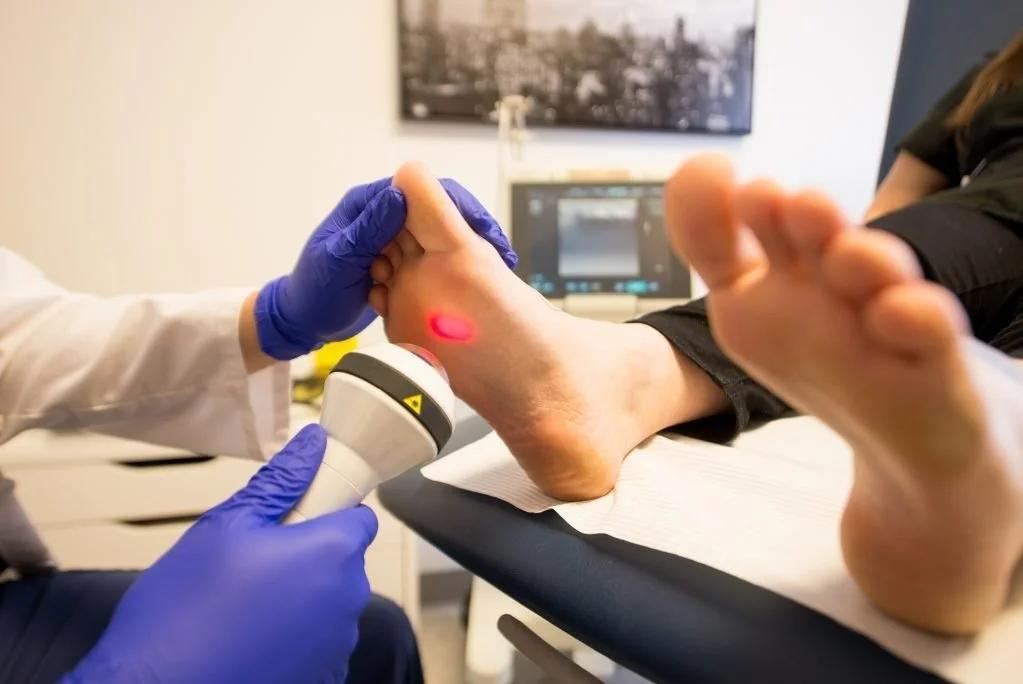
If you have ever questioned which issues low-level laser therapy can help with, this treatment is usually prescribed to heal plantar fasciitis, heel pain, Achilles tendinopathy, and other cases of soft tissue and musculoskeletal injury. At Ian’s Podiatry, we think that healing any chronic foot, ankle, or lower limb pain problem starts with knowing your options. A low-level laser therapy treatment involves delivering light energy into cells without surgery, heat, or other negative effects on the body. In this post, we will tell you more about how low-level laser therapy works and which health problems are most suitable for it after a clinical assessment.
How Does Low-Level Laser Therapy Support Lower-Limb Recovery?
Foot pain that is continuous or an injury that is hard to handle could really limit your mobility. If resting and using ice does not help, seeking other options that are less invasive but still specialized will be crucial. Contemporary podiatry offers various light-based therapies among other techniques for treating foot injuries. One popular method for dealing with persistent lower limb pain is low-level laser therapy treatment.
Such a unique method, which is also known as photobiomodulation, is based on using certain wavelengths of light acting on damaged tissues. The low-level laser does not burn the tissue or cut it like a surgical laser because the technology only delivers low-level light energy that emits little heat. Understanding the nature of this technology, what medical condition it is used to treat, and where it can be applied in a treatment program will help you make the correct choices regarding your lower limb at Ian’s Podiatry.
Struggling with continuous heel pain or plantar fasciitis, limiting your daily walking routine?
Book Your Assessment at Ian’s Podiatry
Understanding Low-Level Laser Therapy in Podiatric Care
LLLT is a completely non-invasive and pain-free therapy meant for stimulating physiological cellular function. In almost all cases, there is a specially designed device that emits controlled light energy applied to the specific skin area.
Its principles include:
- Energy Generation: Photons are transmitted into the biological tissue, influencing the mitochondria, the main source of cellular energy, and leading to ATP generation.
- Process Repair Acceleration: With enhanced ATP generation, repair processes become more efficient, oxidative stress is reduced, and inflammatory pathways are regulated.
- No Painless Surgery: As the therapy involves no skin injuries, no cutting and no burning, there is no recovery period after the therapy.
It should be mentioned that it is vital to understand that LLLT is not a universal therapy and works only in the case of clinical evaluation and successful light targeting on certain tissues.
Common Lower-Limb Conditions Managed with Laser Therapy
While cold laser therapy is used in numerous cases, board-certified podiatrists resort to this technology predominantly for the purposes of dealing with specific inflammatory states, soft tissue and musculoskeletal injuries of the foot, ankle and leg.
-
Plantar Fasciitis and Heel Pain
Plantar fasciitis is associated with inflammation of the tough band of tissue running under the foot. People suffering from heel pain in the morning or during prolonged periods of standing try to avoid any kind of surgical intervention. Cold laser application in the area where the plantar fascia attaches will help relieve pain and promote further healing of the tissue.
-
Achilles Tendinopathy and Tendons Injuries
As the Achilles tendon gets strained quite often due to walking, running, and jumping, the strain leads to the development of pain in the case of tendinopathy, which is linked to the degeneration of the tendon tissue. Cold laser treatment will help relieve the tendon from local stress and restore its load capacity.
-
Soft Tissue Strain and Foot Joint Pain
A sprained ankle, midfoot ligament strain, and joint stiffness in the region of the tarsal bones may all lead to a restriction of normal biomechanics. The use of laser light is a specific treatment method that allows soothing of strained ligaments and reduction of swelling.
How Laser Therapy Fits Into a Comprehensive Care Plan
Depending on a singular machine or modality alone will typically not yield any kind of lasting solution to biomechanically based problems. True resolution will come through careful combination of the use of passive modalities and supportive and functional structural interventions.
When it comes to the treatment of problems associated with the feet or heels, seeing a registered podiatrist in Thuringowa means that passive modalities are only going to be part of a well-balanced treatment approach.
A comprehensive treatment approach may involve:
- Biomechanical Assessment: Spotting any abnormalities in walking or any structural imbalances.
- Orthotic Treatment & Footwear Adaptation: Proper pressure distribution throughout the plantar surface of the foot to reduce strain on the weak soft tissues.
- Rehabilitation Therapy: Intrinsic muscle strengthening, stretching tight calf muscles, and load tolerance training.
- Modalities: Using photobiomodulation to reduce tissue irritation and functional restoration through active rehabilitation.
Through a proper combination of structural adaptations and light therapy, patients will get an ideal mechanical environment for healing foot structures.
Low-Level Laser Therapy vs. Shockwave Therapy
| Feature / Aspect | Low-Level Laser Therapy (LLLT) | Shockwave Therapy (ESWT) |
| Energy Source | Controlled light energy (photons) | Acoustic sound waves |
| Primary Mechanism | Cellular stimulation (Photobiomodulation) | Mechanical micro-trauma & hyperstimulation |
| Patient Sensation | Soft, gentle warmth or no sensation at all | Pulsed mechanical pressure/pulses |
| Best Suited For | Sensitive, acute, or irritable soft tissues | Chronic, calcified, or long-term recalcitrant tendinopathy |
| Invasiveness | 100% Non-invasive, soothing | Non-invasive, intensely tactile |
What to Expect During a Laser Therapy Consultation
If you are looking for laser treatment in Townsville, being aware of how clinical sessions are conducted will be helpful for you in terms of gaining information about what to expect from this procedure. Clinical sessions are conducted in accordance with a particular procedure aimed at ensuring the safety and appropriateness of the procedure.
- Step 1: Clinical assessment: Detailed review of the patient’s medical history, symptoms, shoes that are used every day, and lower limb function.
- Step 2: Differential diagnosis: This step determines whether or not there is an appropriateness of treating your condition using light.
- Step 3: Specific application: Application of the cold laser light on the affected soft tissues. Sessions are brief and painless.
- Step 4: Re-evaluation: Re-assessment during future sessions in order to check how symptoms have improved.
Ready to relieve foot pain and restore your daily mobility through assessment-first care?
Choosing the Right Approach for Your Foot Health
Management of pain in feet and ankles requires a sound management strategy based on appropriate diagnosis and available treatment modalities. Considering the positive effects that come with the use of low-level laser therapy treatment makes it a great non-invasive solution when dealing with hard-to-manage soft tissue injuries such as plantar fasciitis and Achilles tendinopathy. If foot stiffness or heel pain is limiting your physical activities, it is important to have yourself checked first. Contact Ian’s Podiatry and see how our patient-oriented assessment, first care, biomechanics, and treatments can help ease your pain.